Key Use Cases
Tools in Detail
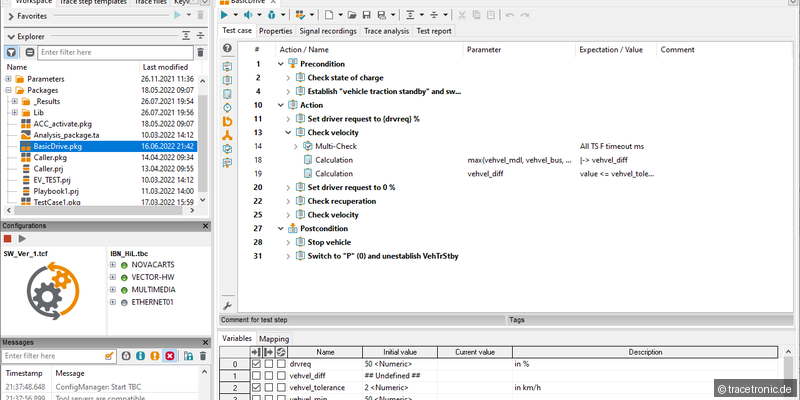
TraceTronic ECU-TEST
The leading automotive test automation tool. Provides a unified test environment across SIL, HIL, and vehicle levels. Supports Python scripting, test parameter management, and hardware abstraction.
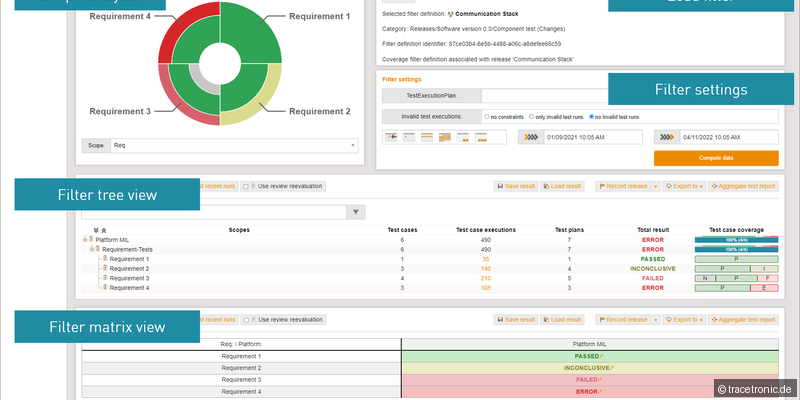
TraceTronic TEST-GUIDE
Test management and reporting server. Aggregates results from ECU-TEST, tracks test coverage, manages test campaigns, and provides dashboards for project-level quality visibility.
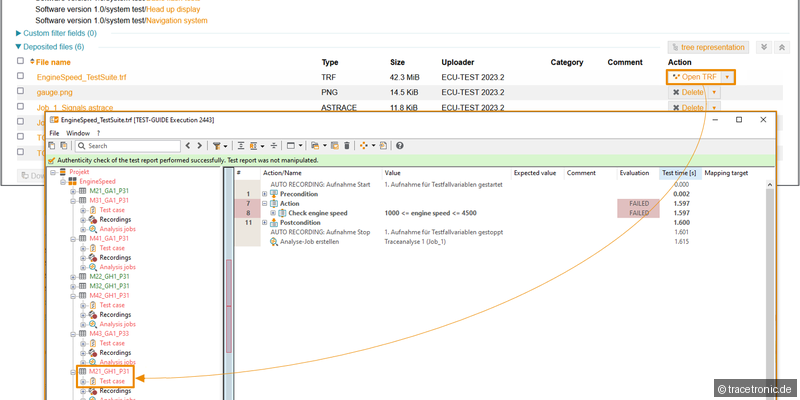
TraceTronic TRACE-CHECK
Signal-based test evaluation tool. Automatically validates recorded traces against expected signal behavior using graphical rule definitions - no coding required.
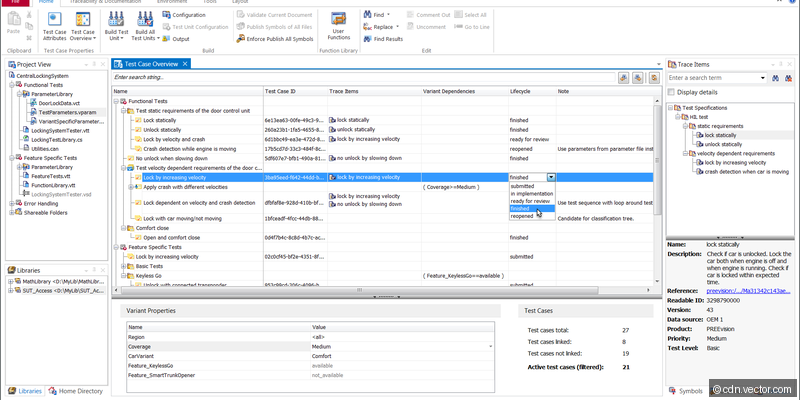
Vector vTESTstudio
Test authoring environment integrated with CANoe. Supports CAPL, Python, and .NET test scripting with built-in test management and requirement traceability.
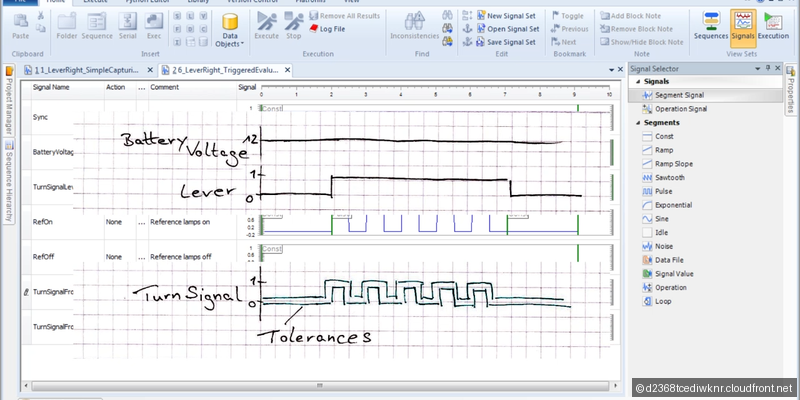
dSPACE AutomationDesk
HIL test automation framework based on ASAM XIL API. Provides graphical test sequencing, Python integration, and seamless connectivity to dSPACE HIL systems.
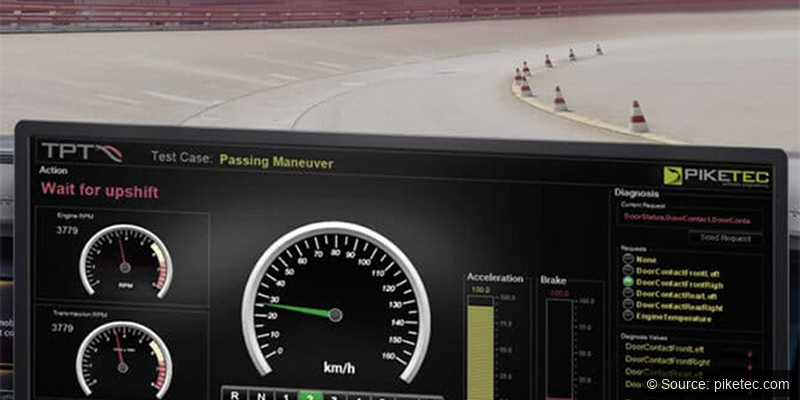
TPT (PikeTec)
Model-based test tool specialized for Simulink/TargetLink testing. Generates test cases from requirements, supports equivalence class testing, and enables back-to-back MIL/SIL/HIL testing.
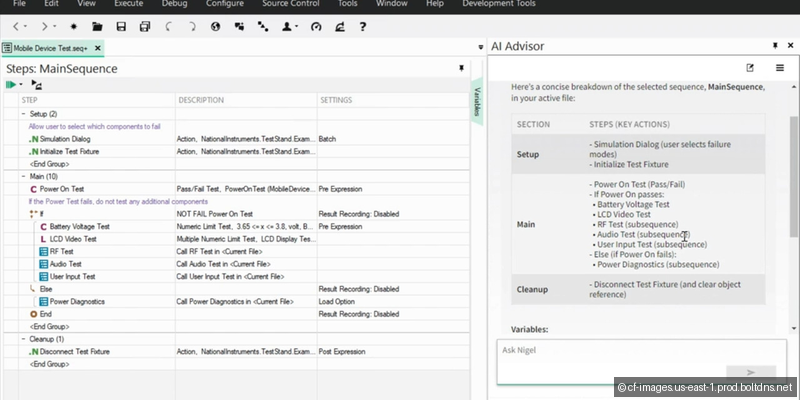
NI TestStand
General-purpose test sequencer from National Instruments. Used for production line testing and validation test stands, supports multiple programming languages and hardware drivers.
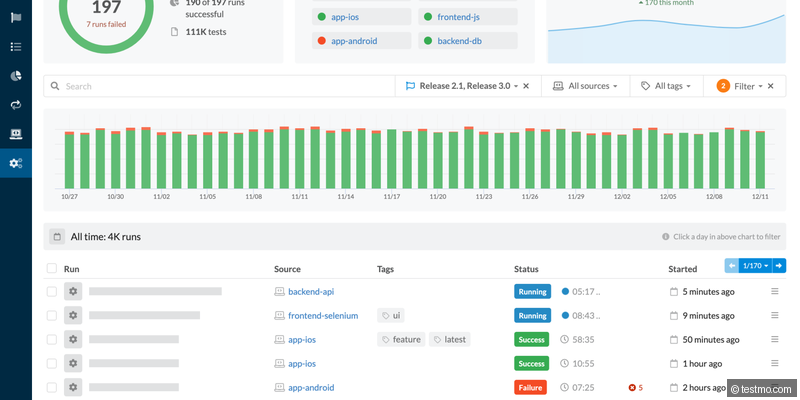
Jenkins CI
Open-source CI/CD server widely adopted in automotive for automating build, test, and deployment pipelines. Integrates with ECU-TEST, CANoe, and MATLAB for end-to-end automation.
Industry Context
Automotive software testing faces a unique scaling challenge: a modern ECU may have thousands of requirements, each needing multiple test cases at MIL, SIL, HIL, and vehicle levels. Manual testing is impossible at this scale. TraceTronic's ECU-TEST dominates because it abstracts the test platform from test logic, enabling reuse across platforms. The integration of automotive test automation with CI/CD practices represents the ongoing convergence between automotive and software engineering cultures.
Typical Workflow
Jenkins orchestrates the CI/CD pipeline. Code commits trigger compilation, static analysis (MISRA), unit tests, and SIL tests via ECU-TEST against virtual ECUs. Nightly builds add HIL test execution on SCALEXIO racks, model-based tests via TPT, and CANoe integration tests. Results flow into TEST-GUIDE for aggregation. Requirements traceability links results to DOORS/Polarion for ASPICE Level 3 and ISO 26262 verification evidence. Release decisions use quantitative quality gates.
Selection Guide
Pro Tips
Design platform-independent test cases from the start - migrating platform-specific tests is extremely costly.
Implement nightly regression testing early, even with a small suite - catching regressions quickly is the goal.
Use data-driven testing to maximize coverage - one parameterized test case covers hundreds of combinations.
Connect test automation to requirements tools from the beginning - retrofitting traceability is massive manual effort.
Monitor HIL infrastructure reliability separately - flaky hardware-caused tests erode team confidence.